
What Is Review Management for E-commerce?
A Practical Guide for Brands
What is review management for e-commerce?
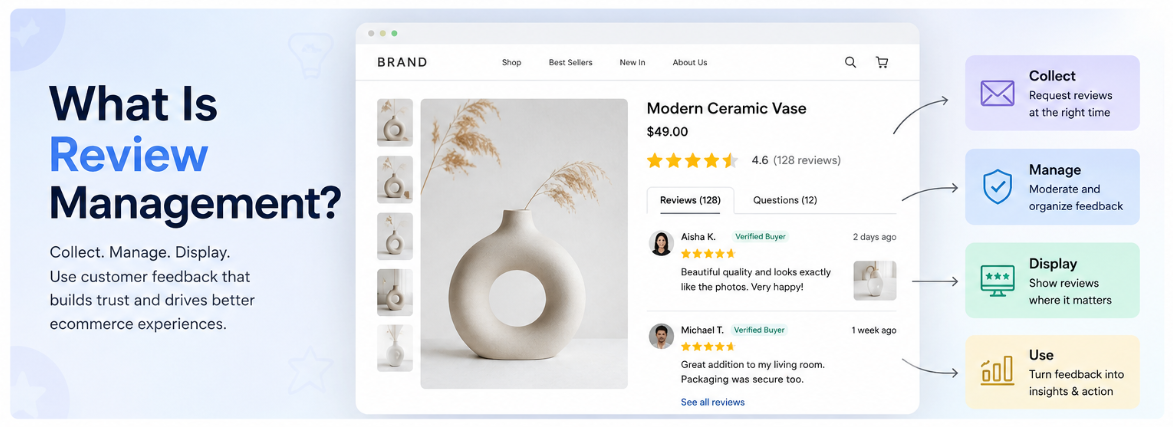
Review management for e-commerce is the process of collecting, managing, moderating, and displaying customer reviews and product ratings across a brand’s online shopping experience. It helps e-commerce teams create a more structured way to handle customer feedback instead of treating reviews as isolated comments or one-off requests.
For brands, review management can cover the journey from review collection and moderation to review display and customer-generated content (UGC). The goal is to make useful customer feedback easier to collect, manage, and use across relevant product experiences.
Key Takeaways
- Review management is broader than simply asking customers for reviews.
- A structured process can cover collection, management, moderation, and display.
- Product reviews can give shoppers more context when evaluating products.
- Reviews can also provide useful customer feedback for brand and product teams.
- Review widgets can help brands place customer feedback closer to product-page decisions.
What does review management include?
Review management can mean different things depending on a brand’s product range, website, and campaign workflow. At its core, it is about creating a consistent process for handling customer reviews and ratings.
A typical review-management workflow may include:
- Collect customer feedback: Give customers an appropriate way to submit reviews after they have experienced a product.
- Organise submitted reviews: Keep customer feedback manageable as review volume grows.
- Moderate reviews: Apply the brand’s review-management rules consistently where moderation is part of the workflow.
- Manage ratings and review content: Organise written reviews and relevant customer-generated content.
- Display reviews: Place useful customer feedback in relevant areas of the e-commerce experience, such as product pages.
Use feedback as customer insight, Identify recurring questions, positive experiences, or areas that may need attention.
The important distinction is that review management is a process, not just a review-request message.
Review collection vs review management
Review collection is one part of review management.
For example, a brand might send a customer a request to review a recently purchased product. That is a review-collection activity.
Review management covers the wider system around that activity: how reviews are gathered, handled, moderated where applicable, and presented to shoppers.
This distinction becomes increasingly useful as an e-commerce business grows. A small number of reviews can be managed manually. A larger and more active product catalogue usually benefits from a more structured approach.
Why do reviews matter for e-commerce brands?
Customer reviews give shoppers information that may not be available from product descriptions alone.
A product page can explain specifications, ingredients, materials, dimensions, features, or intended use. Customer reviews can add another perspective: how people experienced the product in real-world use.
For e-commerce teams, useful reviews can help shoppers understand:
- what customers liked about a product
- questions or concerns customers had before or after purchase
- how a product fits into everyday use
- which product attributes customers mention most often
- what experiences customers consider important
This does not mean reviews automatically guarantee higher conversions or sales. Their value depends on the quality, relevance, visibility, and authenticity of the customer feedback a brand collects.
One2Five’s approved positioning is therefore focused on helping brands collect and manage authentic customer feedback rather than promising a specific commercial outcome.
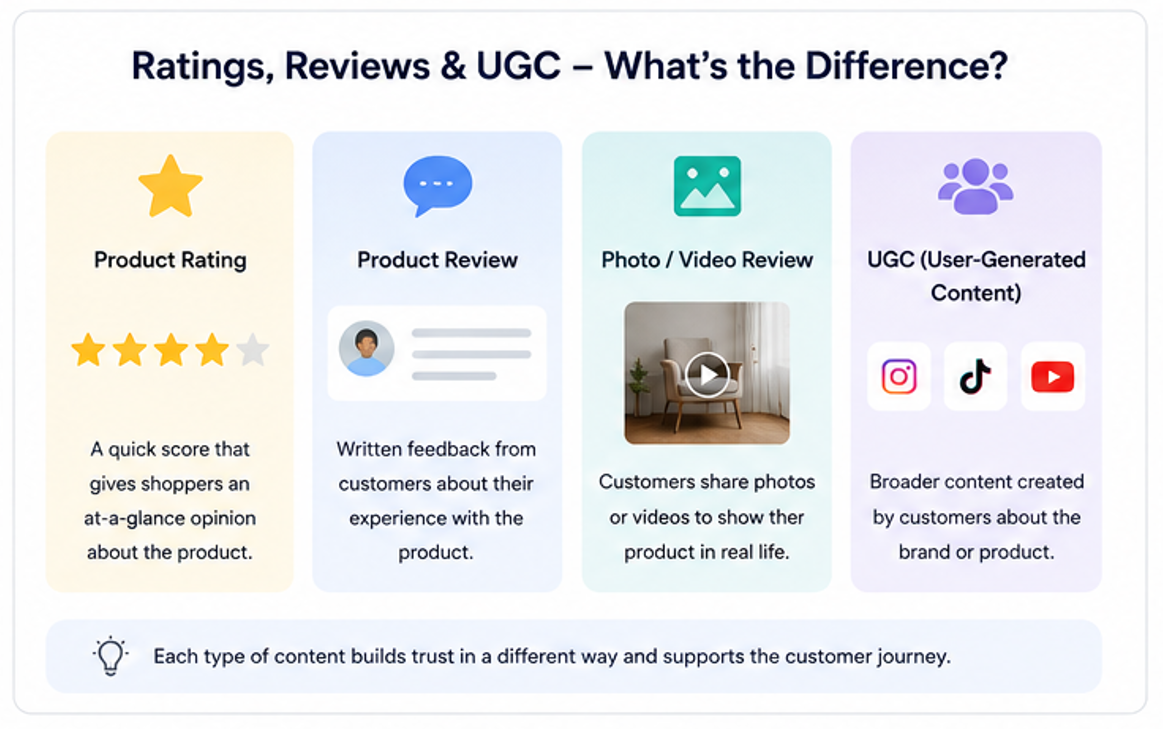
What is the difference between product reviews, ratings, and UGC?
These terms are related, but they are not identical.
Content type | What it is | Typical value for an e-commerce brand |
Product rating | A score assigned to a product, such as a star rating | Gives shoppers a quick summary signal |
Product review | Written customer feedback about a product | Provides more context about the customer experience |
Photo review | A review that includes customer-submitted imagery | Shows the product in a customer context |
Video review | Customer-submitted video content about a product | Can provide a richer customer perspective |
UGC | Customer-generated content created around a brand or product | Can provide authentic customer perspectives for relevant brand experiences |
One2Five’s approved capabilities include review management, customer review collection, product ratings and reviews, review widgets, and UGC support. Photo and video review functionality should only be described as available where specifically confirmed.
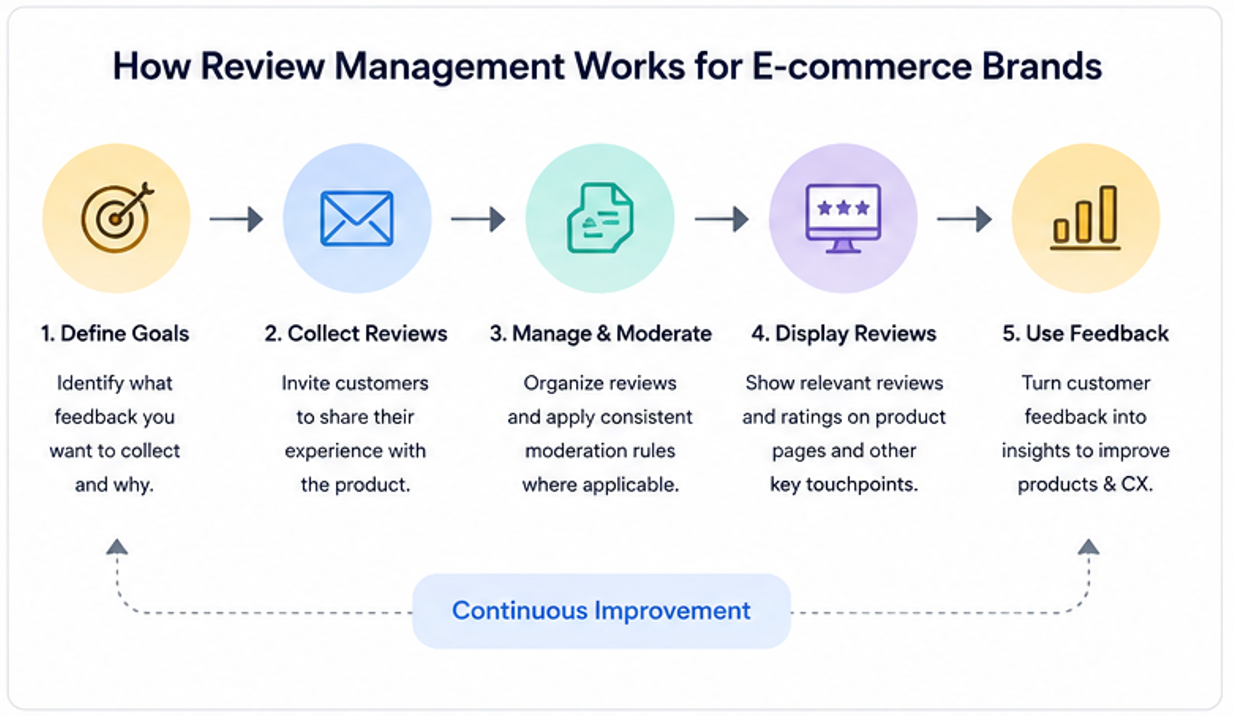
How does review management work for an e-commerce brand?
A practical review-management process can be broken into several stages.
1. Define what feedback you want
Start with the purpose of the review programme.
A brand may want customers to comment on:
- product quality
- ease of use
- design
- packaging
- fit or usability
- overall customer experience
The questions should be relevant to the product rather than asking for generic feedback every time.
2. Create a simple review-collection process
Customers are more likely to provide useful feedback when the process is clear.
The review request should make it obvious:
- what product the customer is reviewing
- what action they need to take
- where they should submit the review
- whether additional content such as imagery is requested
The exact review-request channel should depend on the brand’s confirmed workflow and available capabilities.
3. Manage submitted feedback
As customer feedback increases, brands need a consistent way to handle it.
This may involve organising reviews, applying moderation rules where appropriate, and ensuring customer feedback is managed consistently.
Avoid treating review management as a process for removing every negative comment. A credible review experience needs clear rules rather than simply selecting only positive feedback.
4. Display relevant reviews
Collected reviews become more useful when shoppers can find them in the right context.
For e-commerce brands, product pages are a natural place to display product ratings and reviews because that is where shoppers are evaluating a specific product.
Review widgets can support this type of review-display workflow. One2Five specifically supports review widgets and review-display use cases for brand websites, including Shopify and WordPress contexts where applicable.
5. Review the feedback as customer input
Reviews can also be useful beyond the product page.
Repeated customer comments may highlight:
- frequently praised product attributes
- common customer questions
- recurring usability concerns
- areas where product information could be clearer
This makes review management relevant not only to e-commerce and marketing teams, but also to product and customer-experience teams.
What are common review management mistakes?
A structured review process can help brands avoid several common problems.
Mistake 1: Treating review collection as the whole strategy
Sending review requests is only one part of the process.
A stronger approach considers what happens before, during, and after a customer submits feedback.
Mistake 2: Asking vague questions
“Tell us what you think” may be easy to send, but it may not produce useful product-specific feedback.
More focused questions can make it easier for customers to provide relevant information.
Mistake 3: Making reviews difficult to find
Customer feedback has limited value if shoppers cannot easily find it during the product-evaluation process.
Review display should therefore be considered alongside review collection.
Mistake 4: Treating all customer feedback as the same
A product rating, written review, photo review, video review, and broader UGC asset can serve different purposes.
Brands should define what type of feedback they want and where each type is most useful.
Mistake 5: Making unsupported claims about review authenticity
Brands should not describe reviews as “verified,” “fraud-proof,” or otherwise validated unless the specific workflow supports those claims.
One2Five’s approved-claims framework specifically identifies verified-purchase reviews, AI fraud detection, review syndication, translation, and several other advanced review capabilities as unverified unless confirmed.
How should brands approach review management?
A practical starting framework is:
Step | Question for the brand |
Objective | What do we want customer feedback to help us understand or communicate? |
Collection | How will customers be invited to review the product? |
Questions | What product-specific information do we want customers to share? |
Management | How will submitted reviews be organised and moderated where applicable? |
Display | Where should shoppers see relevant reviews? |
Usage | How can useful customer feedback support the wider customer experience? |
This keeps review management connected to the customer journey rather than treating reviews as a separate content task.
When should an e-commerce brand consider review management?
Review management becomes especially relevant when a brand is:
- growing its product catalogue
- receiving increasing amounts of customer feedback
- building a more consistent review-collection process
- improving product-page content
- introducing review widgets
- looking for a structured way to manage customer reviews and ratings
- connecting customer feedback with broader UGC activity
The right workflow will depend on the brand’s products, customer journey, website setup, review goals, and operational requirements.
How One2Five Can Help
One2Five helps brands with review management, customer review collection, product ratings and reviews, review widgets, and UGC support.
For an e-commerce brand, that can mean creating a more structured approach to collecting and managing authentic customer feedback and making relevant reviews available across the customer experience.
One2Five also supports review-display use cases for CMS websites such as Shopify and WordPress, within confirmed capabilities and workflows.
The appropriate setup depends on the brand’s campaign objectives, product catalogue, audience, website, and review-management requirements.
FAQ
Review management for e-commerce is the process of collecting, managing, moderating, and displaying customer reviews and product ratings. It can also include organising customer-generated content and creating a consistent workflow for handling customer feedback.
Review management gives brands a structured way to handle customer feedback rather than relying on isolated review requests or manual processes. It can also help brands make relevant customer feedback easier for shoppers to find when evaluating products.
No. Review collection is one part of review management. Review management covers the wider process, including collecting, organising, moderating where applicable, and displaying customer reviews and ratings.
A product review is generally customer feedback about a specific product, while a testimonial is usually a broader statement about a brand, product, or experience. The two can support different parts of an e-commerce customer journey.
Product pages are an important location because shoppers are evaluating a specific product there. Brands may also use review widgets or other relevant website placements depending on their website structure and confirmed capabilities.
Yes. Review management can be connected with customer-generated content such as relevant review-related UGC. However, brands should distinguish between product reviews and broader UGC because they may serve different content and customer-experience purposes.
No. Review management does not guarantee a particular level of sales, conversion, review volume, or other commercial outcome. Its purpose is to help brands create a more structured process for collecting and using customer feedback.
Consider whether the solution supports the review workflow the brand actually needs, including review collection, management, display, widgets, and relevant UGC support. Brands should also confirm specific features and integrations before treating them as available capabilities.